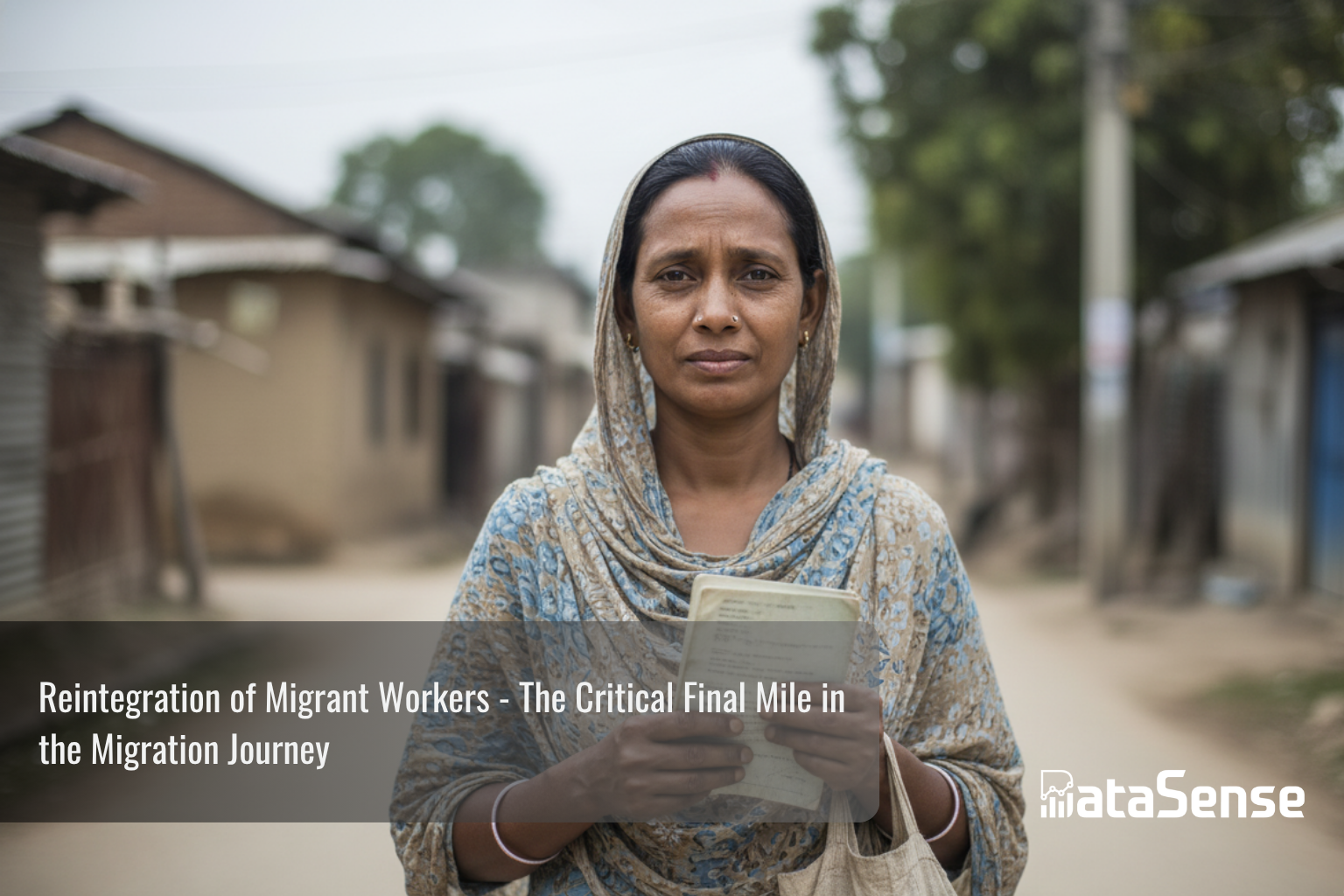
Migration often focuses intensely on the journey out and the work abroad. Yet, the true measure of a successful migration policy lies in the reintegration of returning workers. Reintegration is not merely about arrival, it is a complex, multi-dimensional process essential for ensuring that the human capital, financial savings, and experiences gained abroad translate into sustainable development at home.
What is Reintegration?
Reintegration is the long-term, dynamic process of re-establishing economic, social, and psychosocial well-being in the country of origin. It is broadly defined by four interdependent pillars :
- Economic: Sustainable income generation, often through entrepreneurship or wage employment.
- Labour Market: Utilizing skills acquired abroad through training, certification, and matching with local industries.
- Social: Re-establishing family, community, and social networks, including overcoming discrimination or stigma.
- Psychosocial: Addressing mental health issues, trauma, and distress resulting from the migration experience or difficulties upon return.
Current Scenario of Reintegration Landscape
The Wage Earners’ Welfare Board (WEWB) under the Ministry of Expatriates’ Welfare and Overseas Employment (MoEWOE) plays a central role in supporting Bangladeshi migrant workers and their families through welfare, legal aid, and reintegration assistance. The RAISE Project (Recovery and Advancement of Informal Sector Employment), implemented by WEWB and funded by World Bank, focuses on improving the employability, entrepreneurship, and well-being of returnee migrants. However, for effective and sustainable reintegration, especially for women and youth returnees, one ministry alone cannot address the wide-ranging economic, social, psychosocial, and legal needs of returnees. Reintegration demands a whole-of-government and whole-of-society approach, where ministries, private sector actors, NGOs, and local authorities coordinate their services under a unified framework. Establishing a formal referral mechanism among ministries and service providers is essential to ensure that returnees receive timely and comprehensive support, from training and financial access to psychosocial care and legal aid, without duplication or gaps.
Universal and Gender-Differentiated Challenges
Returning migrants, irrespective of gender, face systemic barriers that prevent savings from being used productively and often lead to high rates of re-migration attempts.
1. Universal Challenges: Debt and Skill Mismatch
The primary obstacle for most returnees is the financial burden and the structural barrier to re-employment:
- Debt Servicing: Many returnees return with significant debt incurred for migration costs. This often leads to rapid depletion of savings and limits productive investment. Studies indicate that up to 70% of initial returned savings are often spent on non-productive uses (debt servicing, consumption) within the first year (IOM, 2022).
- Skill Gaps and RPL: Skills acquired on the job abroad are frequently not formally recognized at home. Approximately 65% of returnees report a mismatch between skills used abroad and local job market requirements, often due to the lack of formal certification (RPL) (BMET, 2023). This forces skilled workers into lower-paid, informal employment.
2. Gender-Differentiated Challenges
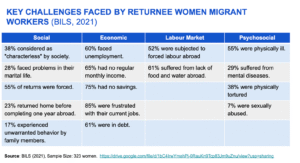
Returnee Women Migrant Workers (RWMWs) face additional, intersecting vulnerabilities that necessitate a specialized approach:
- Psychosocial Distress and Stigma: RWMWs, particularly those who returned involuntarily or as survivors of abuse, are disproportionately affected by trauma. Studies indicate that as high as 45% of female returnees report psychosocial distress (anxiety/depression) linked to their migration experience, compounded by severe social stigma and family conflict upon return (MoEWOE & UN Women, 2021).
- Access to Credit and Childcare: Women frequently lack the necessary collateral or financial literacy for large loans and are excluded from training or employment due to mandatory childcare responsibilities.
Policy Solutions for Effective Reintegration
Addressing these complex challenges requires a standardized, unified, and gender-responsive policy framework that treats every case file uniquely.
1. Multi-Ministerial Approach for Effective Reintegration and Service Delivery
Different ministries and their agencies already provide a diverse range of services that, if effectively coordinated, can holistically meet the needs of returnee migrant workers. For example, the Department of Youth Development (DYD) and the National Institute of Youth Development (NIYD) under the Ministry of Youth and Sports offer entrepreneurship, vocational, and leadership training that can help returnees re-enter the labour market. The Probashi Kallyan Bank (PKB) provides reintegration and startup loans to returnees who complete certified training programs, supporting their transition into self-employment or small business ventures. The Jatiyo Mohila Sangstha (JMS) and Joyeeta Foundation under the Ministry of Women and Children Affairs extend gender-sensitive training, entrepreneurship support, and market linkages for women returnees. Meanwhile, the Department of Social Services (DSS) under the Ministry of Social Welfare delivers psychosocial counselling, allowances, and rehabilitation support for vulnerable returnees. When these services are connected through structured coordination and referral pathways, the government can ensure that each returnee, regardless of their gender, skill level, or location, has access to a full spectrum of reintegration assistance that promotes sustainable livelihoods and social inclusion.
2. Effective Referral Mechanism
A referral mechanism is a structured process that links returnee migrants to appropriate government, financial, and social services through a coordinated and data-driven system. It ensures that each returnee receives comprehensive, timely, and gender-responsive support across multiple ministries. The referral mechanism acts as the operational bridge between migration management and national social protection, health, education, and employment systems.
In Bangladesh, despite the presence of more than 150 reintegration-related services under the Ministry of Expatriates’ Welfare and Overseas Employment (MoEWOE) and its agencies, service delivery remains fragmented. Most returnees navigate a complex landscape of ministries, banks, and NGOs without guidance or linkage. A national referral system, therefore, is essential to institutionalise coordination, avoid duplication, and ensure equitable access to government services.
A referral mechanism begins at the point of arrival, where returnees are received, registered, and provided with immediate information on available services and support options. Once registered, each returnee’s profile, including their skills, health status, vulnerabilities, and reintegration preferences, is documented through an initial enlistment and needs assessment process. This helps identify primary and urgent needs such as temporary shelter, medical care, psychosocial support, or emergency financial assistance. Following this, returnees are referred to relevant service providers through a secondary referral stage, which connects them to mid- and long-term reintegration opportunities like vocational training, employment placement, entrepreneurship programs, or social protection schemes. Throughout this process, case management ensures that every returnee’s progress is tracked, follow-ups are conducted, and services are adapted to their evolving circumstances. Importantly, each step of the referral process must be gender-responsive and sensitive, recognizing that women returnees often face additional barriers such as trauma, social stigma, caregiving responsibilities, or limited mobility. This means designing services that ensure privacy, safety, psychosocial care, and flexible training and employment pathways that cater to women’s distinct needs, ultimately ensuring a dignified, inclusive, and sustainable reintegration journey.
3. Standardization and System Accountability (An SOP Mandate)
Governments must move beyond ad-hoc assistance to implement mandatory, high-accountability SOPs (Standard Operating Procedures) across all service points:
- Unified Case Management: Establish a central, digitized Management Information System (MIS) to track services provided by all ministries. This prevents duplication and ensures standardized, systematic follow-up on service uptake.
- Safety and Equity Protocol: Implement a mandatory Safety & Equity Checklist for every case involving a female migrant for gender responsive and gender sensitive service delivery. This ensures officers prioritize immediate physical safety, legal claims, and psychosocial stability before processing economic applications. This mandatory protocol minimizes harm and institutional bias.
4. Inclusive Financial and Labour Market Solutions
Financial and employment opportunities must be tailored to overcome systemic barriers for all returnees, particularly those facing credit hurdles.
- Flexible Credit Access: Enhance national financial institutions (like Probashi Kallyan Bank) and microcredit financial insitutions to offer specialized, low-interest Reintegration Loans. These programs must allow for social collateral or be linked to the Case Officer’s verified referral to overcome traditional collateral barriers for both male and female entrepreneurs.
- Recognition of Skills: Invest in highly accessible RPL mechanisms to rapidly certify skills gained overseas. This is critical for male returnees who primarily seek formal wage employment in construction or manufacturing sectors.
5. Gender Comprehensive and Confidential Support
Support must be decentralized, confidential, and specifically structured to address the complex needs of women.
- Trauma-Informed Services: Mandate protocols where the Case Officer connects the returnee to a mental health professional (Ministry of Social Welfare) or specialized legal aid (Ministry of Women and Children Affairs for women). This prevents re-traumatization from having to repeat sensitive details to multiple agencies.
- Community Sensitization: Invest in long-term public awareness campaigns in high-return areas to combat the stigma associated with failed migration or premature return, which impacts both men and women.
Case Study – Mohamed Akbar
Mohamed Akbar, a construction worker in Dubai, returned to Bangladesh after a severe workplace injury. Upon arrival, there was no desk or system to assess his condition or refer him to support. Had a referral system been in place, Akbar could have been immediately registered and directed to the National Disabled Development Foundation (JPUF) of Ministry of Social Welfare for assessment and to access the ShuBorna Card benefits. This case illustrates the urgent need for a systematic and compassionate referral mechanism that bridges airport arrival with district-level services, ensuring no returnee is left without care.
Conclusion
While the Ministry of Expatriates’ Welfare and Overseas Employment remains the primary custodian of migration governance, the process of reintegration intersects with the mandates of at least fourteen other ministries and agencies responsible for health, education, skills, financial inclusion, gender equality, and social protection. To operationalise an effective and sustainable referral mechanism for the reintegration of returnee migrants, the Government of Bangladesh should prioritise a few key steps. First, institutionalise coordination through a government circular establishing an Inter-Ministerial Reintegration and Referral Committee, chaired by MoEWOE, with focal points across all relevant ministries. Second, digitally integrate data systems between WEWB, BMET, PKB, and Bangladesh Bank to ensure accurate profiling and monitoring of returnees. Third, develop a national referral guideline and training module to standardise procedures from registration to case closure, ensuring gender-responsive and disability-inclusive practices. Fourth, strengthen local-level implementation by linking district welfare offices, community clinics, and local government bodies through a unified service directory. Finally, mobilise sustainable financing, leveraging both public resources and development partnerships, to scale and maintain the referral system, ensuring no returnee migrant remains excluded from essential services and dignified reintegration.
Author: Munzeleen Sarwar, Business Analyst at DataSense