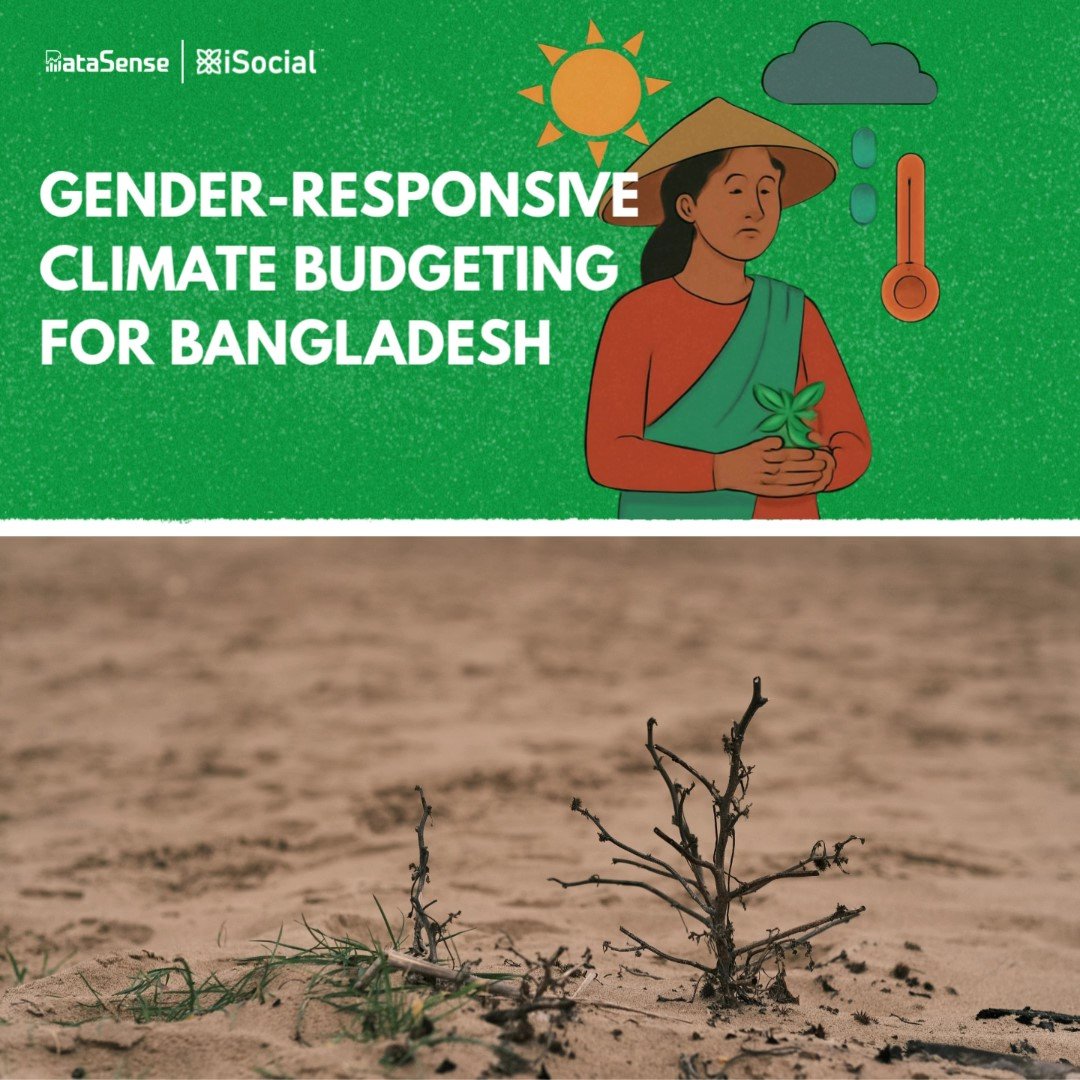
Bangladesh is one of the world’s most climate-vulnerable countries, and this vulnerability is not gender-neutral. Women, particularly in coastal and disaster-prone areas experience disproportionate risks from climate change due to limited access to land, finance, and technology, greater exposure to displacement, and heavier care burdens during disasters. Gender-responsive climate budgeting (GRCB) forms a part of the government’s initiatives to close this gap: it means embedding gender-equality objectives into climate-related public spending so that climate finance actually reaches, and benefits, women.
Where the Budget Stands
For FY2025-26, Bangladesh allocated BDT 260,767 crore to gender-related programs across all 62 ministries and divisions, tracked in real time through the Gender Financial Tracking Model linked to Integrated Budget and Accounting System (iBAS++). This is roughly 30% of the national budget. Climate-related spending stood at BDT 41,208.97 crore (about 10.07% of the budget) across 25 ministries, but unlike the gender budget, climate finance has no fixed target as a share of spending. Both figures are moving in the wrong direction: the gender-relevant share fell to 33.01% from 34.11% the previous year, and climate-focused social safety net allocations dropped sharply to 6%, down from 17%. Reporting quality remains weak too; only 16 of 62 ministries submitted detailed gender budgets for FY2025-26.
Why the Gap Persists
The Ministry of Finance in Bangladesh has built real infrastructure for this work — the Climate Fiscal Framework, Gender Budget Reports, and a Climate Change and Gender Action Plan (ccGAP, 2024). However, climate budget tagging still does not incorporate gender dimensions, and gender sections of Development Project Proposals are often treated as a compliance checkbox rather than genuine analysis. Sex-disaggregated climate-vulnerability data remains scarce, and coordination between the Ministry of Finance, the Ministry of Environment, Forest and Climate Change, and the Ministry of Women and Children Affairs is limited. The human cost of this is visible on the ground: recent field evidence from coastal upazilas found women walking 10-12 kilometers a day to obtain safe water, female-headed households spending 30% more than male-headed ones on adaptation, and men making up 85-95% of participants in community climate consultations. Roughly 85% of gender visibility in climate spending currently goes untracked.
The Way Forward
Two specific, mechanical fixes would move the needle more than any new policy statement. First, raise gender’s weight in the scoring formulas themselves: gender currently earns just 10 of 100 points in the Bangladesh Climate Change Trust Fund’s project-evaluation matrix, and sits under a single sub-code (0605) within only one of the Bangladesh Climate Change Strategy and Action Plan’s six thematic areas. This is a direct cause of the gender-tagged share of the climate budget staying below 1% for five consecutive years (from 0.055% in FY2019-20 to 0.022% in FY2024–25). Second, create a joint gender-climate tag inside the iBAS++ accounting system so the Gender Budget Report and the Climate Financing Report — currently two parallel, unlinked exercises can be cross-referenced project by project. Beyond these two, broader priorities include embedding gender screening at project approval stages (DPP, PEC, ECNEC), expanding sex-disaggregated data collection, and setting a fixed financing target for climate spending, the way the gender budget already has one.
This blog and the associated audio-visual has been developed by Maisha Zaman, Research and Communication Associate, DataSense at iSocial.