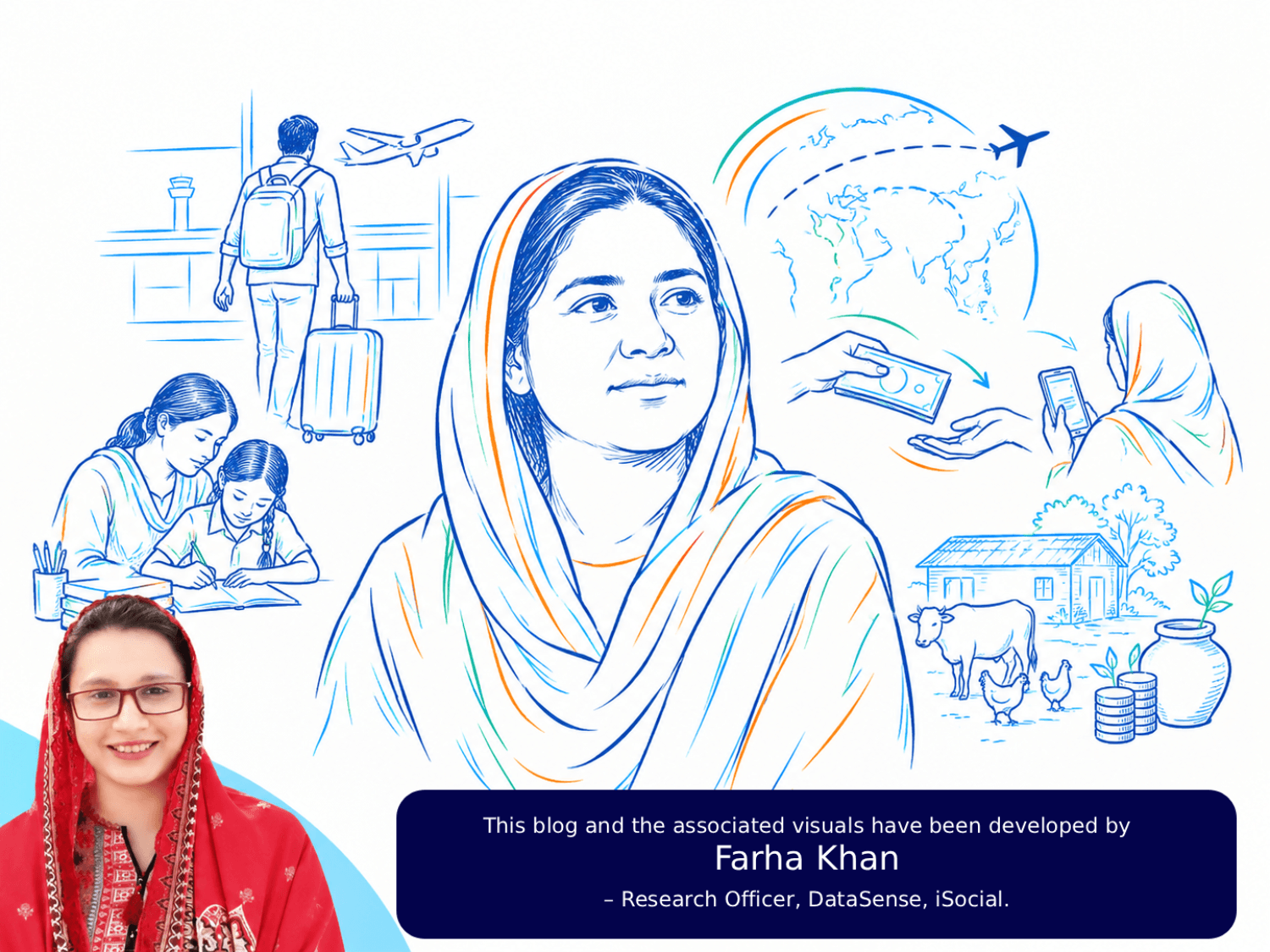
Exploring the dimensions of Remittance utilization by female households
In the villages of Munshiganj, particularly around Sreenagar, remittances from sons and husbands working abroad have become a critical lifeline. Interviews with local women reveal how money sent from Italy, Malaysia, and Singapore covers household expenses, children’s education, and medical costs—while also exposing the heavy burden of migration financing and the limited room left for long-term investments.
Homemakers in the district-level in Bangladesh are thought to be gullible, but findings say that they are dealing with challenges and getting smarter day by day. Munshiganj, it is most famous for being the historic region of Bikrampur and potato-producing hub in Bangladesh. Nowadays Munshiganj’s people prefer to go abroad for odd jobs; the data from Bangladesh Bank says remittance inflow from this district is 169.2 million USD in July-September 2026 alone. We went to Munshiganj to gather some insights; we were amazed by their hospitality. Let us explore the findings together.
Informal path for going abroad results in Remittance uncertainty
Sending a family member abroad often requires substantial upfront capital. One respondent, a mother, reported spending around 23-lakh taka to send her son to Italy via an irregular route that passed through Libya. Most of the funds came from relatives through informal reciprocal lending; only two Lakh taka was borrowed from an NGO for one year at an interest rate of 13,500 taka per Lakh. Repayment of the NGO loan was nearly complete, handled mainly through the husband’s painting income, while relative debts lingered longer. Gold jewelry was sometimes sold to meet urgent needs and preserve family ties.
In contrast, a family that sent a son to Malaysia through an official government-linked process paid approximately 6.8 lakh taka. They used savings (including fixed deposits that could not be broken immediately) and one lakh taka borrowed interest-free from siblings, which was repaid within one-and-a-half months after selling a cow during Eid. Another household financed a husband’s 2023 departure to Malaysia for 4.5 lakh taka with loans from Probashi Kallyan Bank (2 lakh taka plus interest) and Buro Bangla (2 lakh taka), supplemented by 50,000 taka of their own and family money. Repayment stretched over years and created early budgeting strain when initial remittances were lower
Case: An Informal Path Saga
Rima (not her real name), a woman who went through a lot of ups and downs in her life, she was married to her husband when she was just sixteen years old, she has three daughters and one son. She loved and cared for her son a lot, after her son, Joy, completed HSC exams, he requested to try going abroad and said to his family to prepare financially. In the meantime, Joy went for training in Dhaka for driving, welding and other skills, there he was entertained by a group of brokers who said they can take him to Italy through illegal channel if he can manage 23 Lakh Taka. Joy spoke to his family about managing the money, as source seems authentic, as his close relative was also involved. His family took loan from family members about 21 Lakh Taka and 2 Lakh Taka loan from NGO. Joy said farewell to his family and started his journey to uncertainty. Little did he know what he is going to face will be a nightmare. He started his journey through flight then at the time of layover, he managed to get away by the help of brokers; Rima said, “At first, Joy travelled from Bangladesh to Dubai, he stayed at the Dubai airport for 19 hours. After 19 hours, they took him back to Egypt. After reaching Egypt, they stayed there for about one to one and a half hours. Then they took him by plane from Egypt. Halfway through the journey, there was a designated place arranged by the broker.” Broker’s responsibility was just to arrange a boat to Libya, Joy was encountered with a challenge of staying in dark place without making noise, they were living in miserable conditions in a small room with 15 to 20 people.
Thus, the experience gets worse, when they travelled from Libya to Italy via boat, they were encountered by tumultuous rollers in the ocean, and people were remembering their creator in various ways, at last they saw a ship but there was nothing to climb on it, people waited for the waves to rise at height of the ship then jumped on it as soon as the boat is close enough. Meanwhile Joy was the last one to bound on to the ship, he tried to save a man who fell into water by a rope, unfortunately the rope slipped and the man was crushed between ship and boat. During this period, he could not make any contact with his family. Rima was worried sick about her son. After one month and five days he contacted his mother and told her he was all right and he did not get any job yet but being in a troublesome situation, he could not share any vital information. Meanwhile back home, as job or remittance were uncertain their lenders were wanting money back, so Rima used to sell off her gold and completed several repayments. Eventually after vicissitudes, Joy reached Italy and started working after six months since he left Bangladesh. Joy sends remittance regularly nowadays; Rima allocates the remittance by meeting immediate household needs and prioritizes debt repayment over investment.
How Remittances Are Used
Utilization is pragmatic and debt-driven. In households still servicing large migration loans, most incoming money goes first to repayment. Remaining funds cover food, education (tutors, travel, and fees can reach 10,000 Taka monthly in some cases), utilities, and medical needs—including chronic medicine costs exceeding several thousand Taka. One long-term Singapore remittance recipient reported irregular transfers timed to extra needs; she has been drawing down earlier fixed deposits to maintain the household while starting a small cake-and-sweets business supported by her husband.
Moreover, we have seen that some respondents were comfortable to take loan from family, as it is interest free and payback period is convenient enough, this is true for formal channels migrants as they start to send remittance effectively through banking channels. The financial literacy is very acknowledgeable that homemakers use Mobile Finance Services (MFSs) such as Bkash for small transactions and influences their close ones to do so. Many households such as women have a subsidiary income from their livestock businesses such as dairy farms, hen-duck farm etc. They are earning a handsome amount of money from selling eggs, milk, hens, ducks, and even cows during Eid-ul- Adha period. They are saving money about 2000 to 5000 Taka in Buro Bangladesh or banks selectively Dutch-Bangla Bank PLC, Grameen Bank & Agrani Bank PLC. We did notice some felt distrust in National Bank PLC and switched to other convenient banks due to liquidity crisis.
Several women manage day-to-day finances jointly with husbands or independently. They combine remittances with local earnings from tailoring, cattle rearing for Qurbani, or small poultry farms; Savings occur in modest forms: weekly or monthly deposits with NGOs or Bank’s DPS schemes, clay piggy banks, or residual cash kept at home. Major asset purchases such as land remain rare so far; high local land prices (often several lakh Taka per decimal near roads) and ongoing education and repayment pressures limit new investments. Plans for future expansion of farms or businesses are common once debts ease.
Families generally report improved stability compared with pre-migration years. Remittances buffer against lower local earnings or unexpected costs and reduce pressure on the remaining household earners. Yet consumption has raised with children’s schooling and general price increases, and savings growth is constrained.
Looking Ahead
Rima’s story shows how far a family will stretch to send a son abroad, and how long the effects last. The NGO loan is nearly repaid, mainly through her husband’s painting income, while the debts to relatives have lingered longer. During the months when no job or remittance had come through, lenders wanted their money back, and Rima sold her gold to complete several immediate repayments. Until these debts are cleared, little is left over for savings.
Across the households we visited, families said they want to save and become entrepreneurs and financially independent once debts ease and plans to expand farms or small businesses are prominent.
What would help families like Rima’s case
- Lower official migration costs. A family that went through an official process to Malaysia paid about 6.8 lakh Taka, against 23 Lakh Taka for Rima’s irregular route to Italy.
- Better information on formal opportunities. Joy met the brokers during skills training in Dhaka, and the offer seemed genuine because a close relative was involved.
- Financial literacy training. Many women already use mobile finance services such as bKash and save 2,000 to 5,000 Taka through NGOs or banks. Continued or expanded training would build on that.
- Vocational training in the cottage industry. Women respondents asked for more of it.
Rima’s case is a reminder that the route a family chooses decides how much of the remittance reaches them, and how soon.
This blog and the associated visuals have been developed by
Farha Khan
– Research Officer, DataSense, iSocial.